A forge is not a 3D model. It is a small program that builds one.
That sounds like a minor detail until you want to change something. With a normal 3D file, making the wall 2mm thicker means opening it up and modelling it again. With a program, it is a number. You change the number and everything that depends on it moves too. The part was never a frozen shape, it was a set of rules for making that shape.
Here is what that actually gets you.
The source is yours, and it runs without us
Every forge is code, and you can take it. Published forges can be cloned with plain git, no account and no special tool:
git clone https://www.partforge.ai/git/your-part.git
What you get is a folder of readable JavaScript. It runs on partforge, which is MIT licensed and on npm, and the geometry underneath it is open source too. There is no hidden format, no license server, and nothing that stops working if we do. You can host the result yourself on any static web host, and a few people already have.
This is the part we care most about. You should not have to trust us to keep owning the thing you made.
Any agent can pick it up where you left off
Because a forge is ordinary code, it is not tied to the assistant that wrote it. Clone it, point Claude Code or any other coding agent at the folder, and ask for changes. It reads the same source ours did.
That works in the other direction too. The part is described in plain JavaScript, so an agent can translate it. If your workshop runs on OpenSCAD, or Python, or something in-house, you can ask for a version in that language and get something a person on your team can actually maintain. The geometry is written down as intent (a bore of this diameter, a fillet of this radius), which is the kind of thing that survives a translation. A mesh is not, because by the time a shape is a pile of triangles, the reasons are gone.
Changes stay small
This is the quiet one, and it might be the biggest.
When you ask for a tweak, the assistant does not rebuild your part from scratch. It edits the lines that need to change, the same way a developer would patch a file. The rest of your part stays exactly as it was.
That matters more than it sounds. It means the twelfth change does not undo the third one. It means asking for a bigger bore does not quietly restyle the flange you spent twenty minutes getting right. And it means you can keep going for as long as you like, because each step is a small edit to something real, not a fresh roll of the dice.
Some numbers become dials
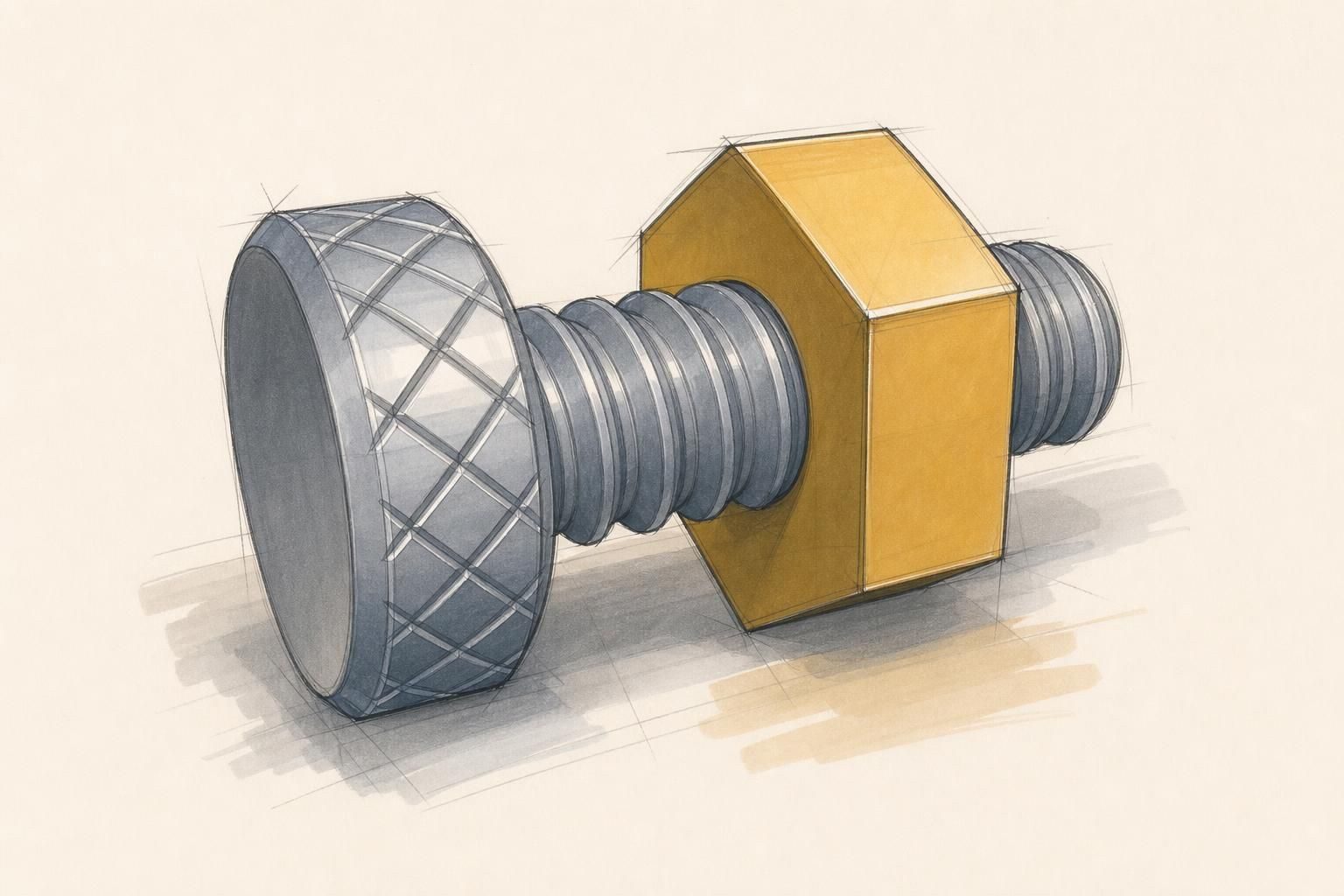
A forge can hand you specific numbers to play with. The printable nut and bolt in our library offers a few head styles: a classic hex, a smooth knob, knobs with vertical ribs. Those are not three separate models. They are one model with a choice in it.
When a forge exposes controls like that, they show up beside the viewer. Move one and the part rebuilds in front of you. Keep the value and it gets written back into the source, so the next person to open it starts where you finished.
You can ask for this directly. "Make the wall thickness adjustable" or "let me change the bolt size from the panel" is a normal thing to say, and it is often the most useful thing to say right before you share a part with someone else.
What it costs
One honest downside: a program can fail to build, and a plain 3D file cannot. Every so often you will get an error where you expected a shape.
That is the trade. Geometry that stays editable has to be computed fresh every time, from rules that have to hold together. When it breaks you can ask for a fix, and usually the error says what went wrong. But it is a real cost and we would rather name it than pretend it away.
Exports are still just exports
None of this makes what you print exotic. Export an STL for your printer, or a STEP file if you need exact surfaces for CAD. They are the same files you would have got by modelling the part by hand.
The difference is what you still have afterwards.