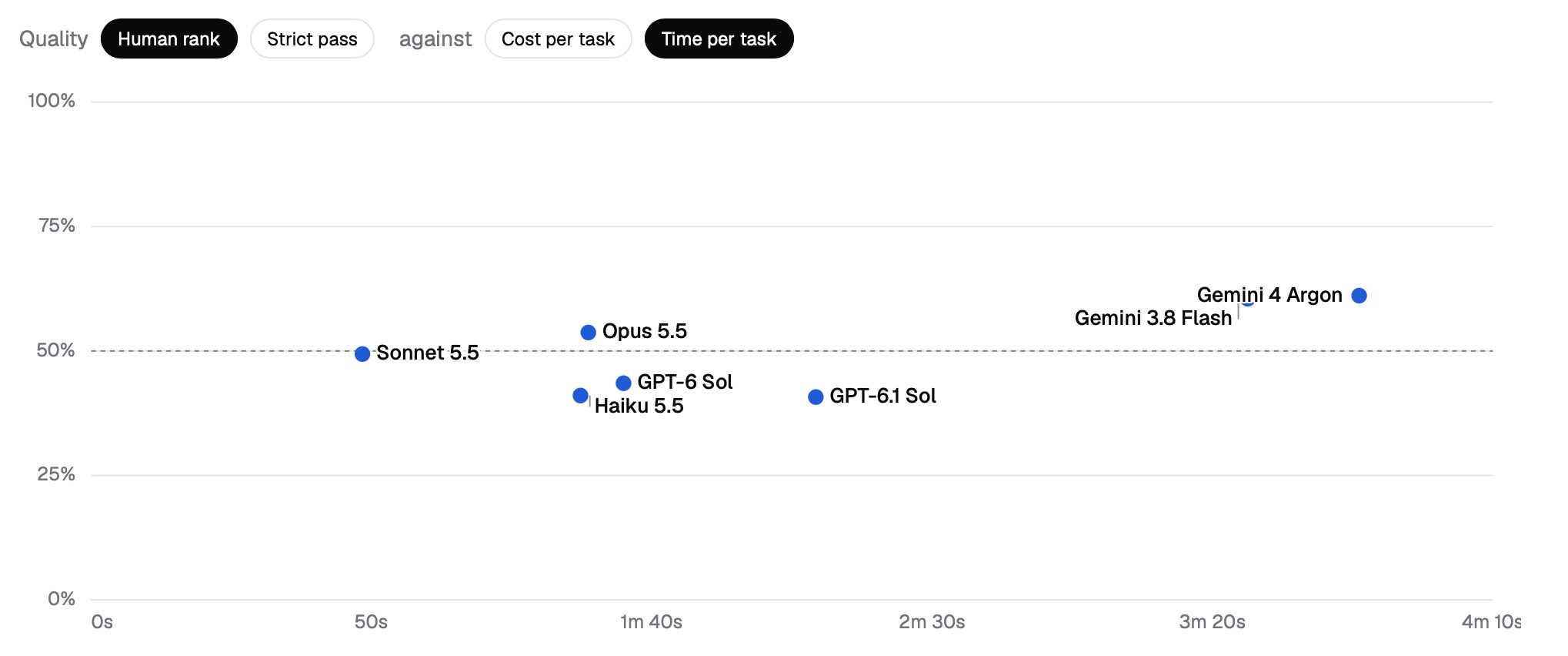
New chats in PartForge now run on Claude Sonnet 5.5, replacing Gemini 3.8 Flash, which has been our default since September. We're treating this as a trial and will watch it for a couple of weeks before we decide to keep it. The reason for the change is speed. On our hardest tests, the top models now score about the same, but how long they make you wait still varies a lot.
You and the AI work together
In PartForge, you and the AI build the part together. The AI writes the code, builds the model, checks what it made and shows you the result. But you know things the AI doesn't, like the part you're trying to fit, the printer you'll use and what you actually meant by "a bit taller."
So a session goes back and forth. The AI builds, you look, you steer, and it builds again. We designed it this way on purpose, because a person checking the work catches mistakes that no test score will.
That only works if each step is quick. If you wait two minutes every time, you stop watching. You check your email, then come back to find the AI went the wrong way three steps ago. When a step takes under a minute, you stay with it and catch problems as they happen. A faster model saves you time, but more than that, it keeps you in charge of the work.
What our tests showed
Our latest test run gave each model our 27 hardest tasks, with three tries each. They include parts that have to fit real hardware, parts rebuilt from a photo, and changes made over several messages. Every model used the same instructions our users get, and you can see every attempt on our results page.
| Model | Score | Typical time per task | Cost per task |
|---|---|---|---|
| Claude Sonnet 5.5 | 91 | 48 s | $0.13 |
| GPT-6 Sol | 90 | 94 s | $0.22 |
| GPT-6.1 Sol | 88 | 121 s | $0.18 |
| Claude Opus 5.5 | 88 | 80 s | $0.38 |
| Gemini 3.8 Flash | 88 | 143 s | $0.20 |
| Claude Haiku 5.5 | 88 | 81 s | $0.02 |
| Gemini 4 Argon | 87 | 132 s | $0.32 |
The scores are close. All seven models are within four points, and with three tries per task, a gap that small doesn't tell you much. The times are not close at all. Sonnet 5.5 finished a typical task in 48 seconds, while Gemini 3.8 Flash took 143 seconds, about three times as long. Sonnet 5.5 was also about a third cheaper than Flash, and it passed our build checks 96% of the time, tied for the best.
One result didn't go Sonnet's way. When we ranked every attempt by hand, Gemini 4 Argon, Gemini 3.8 Flash and Claude Opus 5.5 all came out ahead of it. We still think the speed is worth it, since you're there to catch what the AI misses, but it's one reason this is a trial.
Did the models get faster?
We expected every model to be faster than in our September tests. That's not quite what happened.
- The speed came from new models. Claude Sonnet 5.5 is the fastest model we've tested on hard tasks. In September, the fastest took 72 seconds.
- Most older models stayed about the same. Claude Opus 5.5 took about 80 seconds both times, and GPT-6 Sol went from 100 seconds to 94.
- Gemini 3.8 Flash got slower. Its typical task time went from 72 seconds to 143. Some of that may be changes on our end, but it helped make the decision.
- Every model used about half as much text as before. Most of that came from our side. We shortened our instructions, and our tools now need fewer steps, which is why costs went down across the board.
How the other models did
Claude Opus 5.5 is our pick when a hard part has to be right the first time. It had the top score in September and came third in our hand ranking this time, though it's also the most expensive model here at $0.38 a task. We tried it with less thinking time too, on its "medium" setting. It scored the same, cost about 23% less and finished about 25% faster, so if you use Opus 5.5 for CAD in PartForge, medium is worth a try.
GPT-6 Sol is still a solid all-rounder. GPT-6.1 Sol, the newer version, costs a little less and runs a little slower, and the two scored about the same.
On the Gemini side, Gemini 4 Argon came first in our hand ranking, but it's slow and the most expensive Gemini model on this list. Gemini 3.8 Flash worked well for us for six weeks and is still a good, cheap model. It's just slower now than Sonnet 5.5.
Claude Haiku 5.5 surprised us. It scored the same as Opus 5.5 and Flash, at about two cents a task.
In September we also tested GPT-6 Luna and DeepSeek V4.1 Flash, which were both cheap and did well. Kimi K3 and Kimi K3 Fast had trouble making edits and didn't finish enough tasks to rank.
Choose your own model
You don't have to use the default. Turn on Advanced Model Management in Settings, and you can pick a model for each chat from Claude Opus 5.5, Claude Fable 5.1, Claude Sonnet 5.5, GPT-6 Astra, GPT-6.1 Sol, Gemini 3.8 Flash and Gemini 4 Argon. You can also connect your own Anthropic, OpenAI or OpenRouter account, and chats on those models are billed to you.
We'll share what we learn from this trial, and we'll keep posting every test run as the models change. If you notice Sonnet 5.5 doing something you don't like, or something great, let us know.